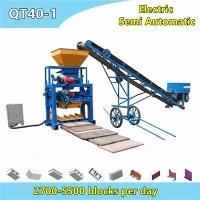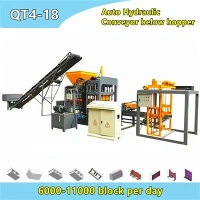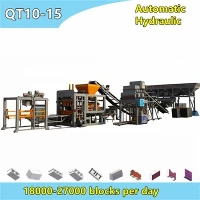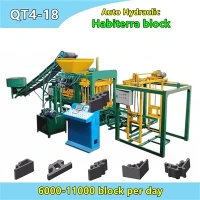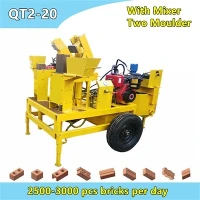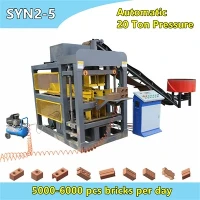


As demand for clay bricks continues to develop in construction, rural development, landscaping, and specialty building projects, manufacturers are placing greater emphasis on automation, forming stability, and production efficiency. A fully automatic hydraulic clay brick making machine combines hydraulic forming technology with automated controls to mechanize processes such as feeding, material distribution, pressing, and demolding, providing an integrated solution for higher-volume clay brick production.
A high level of automation is one of the machine's defining characteristics. The equipment can coordinate material handling, feeding, distribution, pressing, and demolding according to a programmed production cycle, reducing the amount of repetitive manual work required. For continuous production, automated operation helps different stages work together more efficiently and makes overall production management easier.
The hydraulic pressing system is the core of the forming process. Unlike manual forming or basic mechanical methods, a hydraulic system can provide controlled forming force and maintain a more consistent pressing cycle. Proper compaction helps the clay material form a stable green brick within the mold. The appropriate pressure settings depend on factors such as the raw material characteristics, brick dimensions, and machine configuration.

Mold flexibility is another important characteristic. Clay bricks are manufactured in different dimensions, thicknesses, and profiles, so the forming mold must match the intended product. Some machines support interchangeable molds, allowing manufacturers to produce different brick specifications. Mold precision and durability have a direct influence on dimensional consistency and the surface quality of finished bricks.

A continuous production workflow is another advantage of automated equipment. By coordinating feeding, material distribution, forming, and demolding, the machine can reduce unnecessary interruptions between production stages. When integrated with conveying, pallet handling, or other auxiliary systems, it can support a more continuous manufacturing line.
The machine is also generally equipped with an electrical control system that manages production movements and operating status. Depending on the configuration, sensors and operator interfaces may be used to monitor key processes and simplify parameter adjustment and equipment management.
It is important to recognize that production performance does not depend solely on the level of automation. Clay particle composition, moisture content, plasticity, material preparation, mold condition, and subsequent curing conditions can all affect the quality of the finished products. Production parameters should therefore be adjusted according to the actual raw materials and product requirements.
Overall, fully automatic hydraulic clay brick making machines are characterized by a high level of automation, controlled hydraulic forming, flexible mold options, and coordinated production processes. For manufacturers producing clay bricks in larger quantities, selecting appropriate equipment and maintaining standardized operating practices can help improve productivity and product consistency.