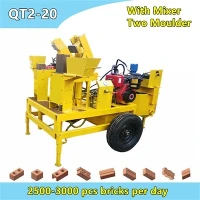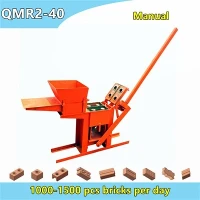


As construction, road development, landscaping, and infrastructure projects continue to expand, brick manufacturing is increasingly moving toward mechanized, continuous, and automated production. In addition to the main brick making machine, supporting equipment for material preparation, mixing, conveying, and pallet handling also plays an important role in overall production efficiency. A properly configured supporting system can connect individual processes more effectively and provide stable equipment support for brick manufacturing.
Supporting machinery for brick production typically includes raw material processing equipment, mixing systems, conveying equipment, forming auxiliaries, palletizing systems, and electrical control components. Each unit performs a specific task, while conveyors and control systems connect the different stages into an integrated production process.
Raw material processing equipment is generally located at the beginning of the production line. It may be used for screening, crushing, measuring, and storing materials such as aggregates, powders, clay, and other suitable ingredients. Depending on the characteristics of the raw materials, the system can incorporate different hopper, screening, and crushing configurations. Proper material preparation helps establish more consistent particle size and proportions for subsequent mixing and forming.
The mixing system normally consists of a mixer, feeding equipment, and supporting structures. Its function is to combine different ingredients thoroughly according to the production requirements. The design needs to balance mixing uniformity, feeding and discharge efficiency, and ease of cleaning and maintenance. In a continuous production line, the mixer must also operate at a suitable pace relative to the upstream and downstream processes.
The conveying system transfers raw materials and newly formed products between different stages of the production line. Common configurations include belt conveyors, chain conveyors, and other conveying systems suitable for the operating environment. Properly designed conveying routes can reduce manual handling and help maintain a continuous production flow.
After forming, green bricks may need to be transferred, stacked, or prepared for curing. For this reason, some production lines incorporate automated palletizing equipment and finished-product conveying systems. Mechanical grippers, clamps, or other handling devices can arrange and transfer the products according to predetermined patterns.
The electrical control system is another important component of the overall production line. Control cabinets, sensors, and operator interfaces can coordinate the operating status of different machines and provide centralized production management. More advanced systems may also monitor key production stages in real time.
Overall, supporting machinery for brick production is characterized by modular construction, coordinated operation, and the ability to form a continuous workflow. Different equipment modules can be combined according to production requirements to create a complete process from raw material preparation to finished-product handling. With appropriate equipment layout and process integration, manufacturers can improve production efficiency and develop flexible solutions for brick manufacturing projects of different scales.