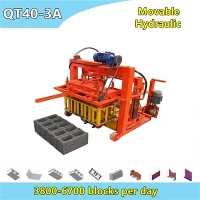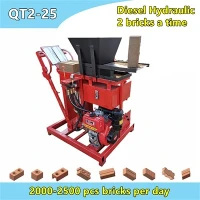


As demand for clay interlocking bricks continues to grow in landscaping, rural development, courtyard paving, and specialty road projects, manufacturers are seeking more consistent and efficient production methods. A clay interlocking brick making machine can handle feeding, pressing, forming, and demolding mechanically, but its performance also depends heavily on raw material preparation, process settings, and operator practices. Proper operating techniques can help improve forming stability and overall equipment efficiency.
Raw material preparation should be addressed before production begins. Clay particle size, moisture content, and plasticity can all affect the forming process. The material should therefore be screened, crushed, and thoroughly mixed, with moisture adjusted according to its actual condition. Material that is too dry may be difficult to compact, while excessive moisture can interfere with demolding and reduce the stability of freshly formed bricks. Maintaining consistent material characteristics is an important foundation for reliable production.
During the feeding stage, operators should observe how the material is distributed inside the mold. Uniform filling helps reduce variations in brick density and supports more consistent forming. If certain areas receive too little or too much material, the feeding system, hopper, and material flow should be inspected rather than simply increasing the pressing force.

Pressing parameters should be adjusted according to the brick dimensions, mold design, and raw material characteristics. Different interlocking brick profiles may require different pressing forces and cycle times. Trial production can be used to determine suitable settings for a specific product. Excessive pressure may increase mechanical loads, while insufficient compaction can affect the density and stability of the green bricks.
Mold management is another important part of efficient operation. Before production, operators should confirm that the mold matches the product design and check the mold cavity for residual material, excessive wear, or deformation. Keeping the mold clean helps maintain clearly defined edges and interlocking features. If brick dimensions gradually begin to change, the condition of the mold should be checked promptly.
Demolding should be carried out smoothly to prevent sudden impacts on freshly formed bricks. Newly pressed bricks should be transferred and stacked according to their strength and handling condition. Moving them too early or applying excessive force can damage corners and interlocking features.
Operators should also develop the habit of recording production parameters. Information such as raw material condition, pressing settings, production output, and unusual events can provide valuable references for future adjustments. After production, the molds, hopper, and work area should be cleaned, while routine inspections and maintenance should be carried out according to the equipment manufacturer's requirements.
Overall, effective operation of a clay interlocking brick making machine depends on proper material preparation, uniform feeding, appropriate pressing parameters, careful mold maintenance, controlled demolding, and accurate production records. By following standardized procedures and making adjustments based on actual production conditions, manufacturers can improve equipment utilization and product consistency while supporting more reliable brick production.